research
Quantum information, quantum many-body physics, and machine learning.
My work sits at the interface of quantum information, quantum many-body physics, and artificial intelligence, with one organising goal: identifying quantum computations that are both verifiable and practically useful. It runs along three lines.
Quantum advantage and its classical boundary
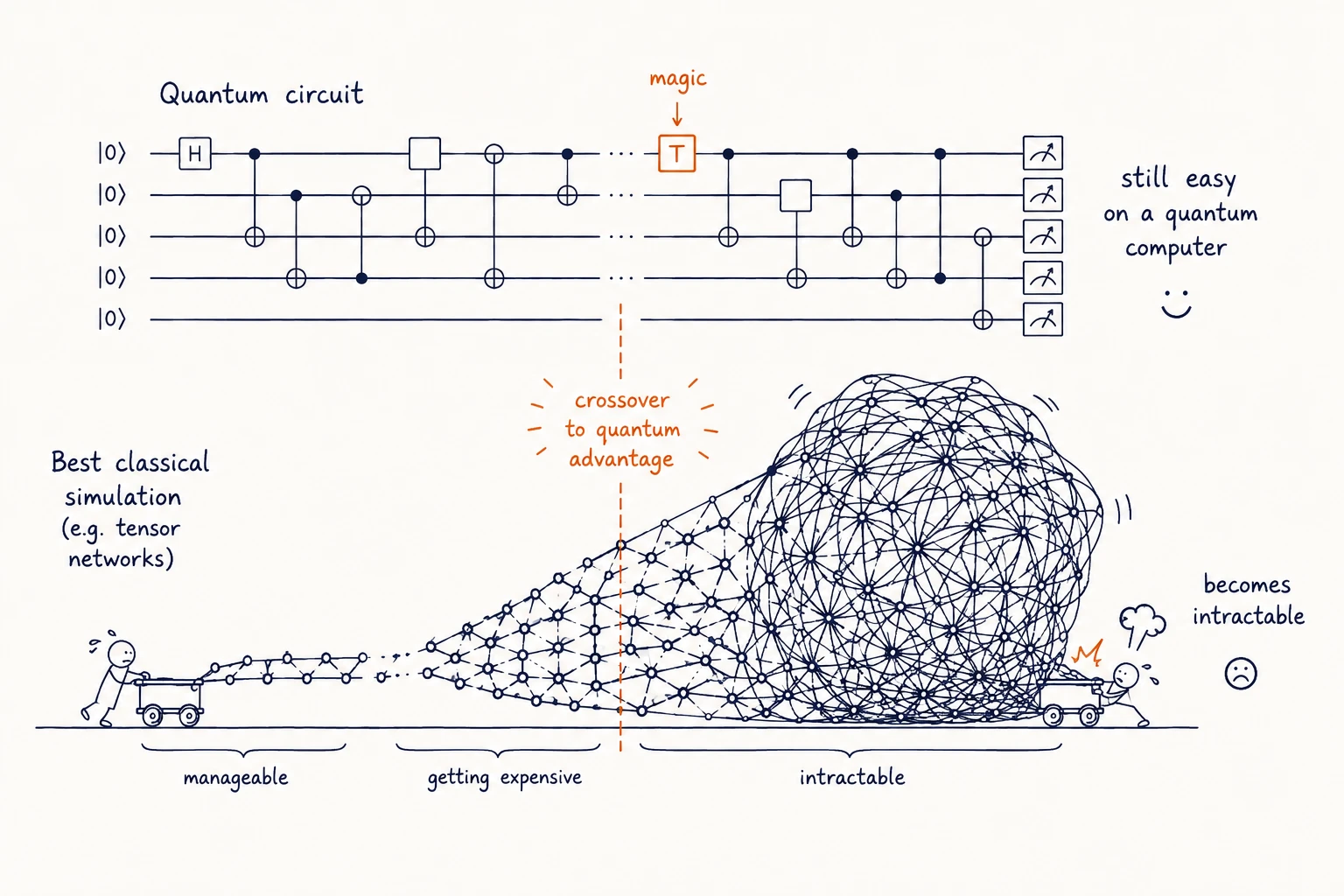
Sampling experiments have demonstrated quantum advantage, but their outputs are hard to check. I study circuit families — such as peaked circuits — whose outputs can be verified efficiently on a classical computer, together with the complexity-theoretic evidence for their hardness. The flip side is knowing exactly what classical algorithms cannot do: I develop tensor-network and Pauli-path methods that push classical simulation as far as it will go, and prove structural results that map the boundary between the classically tractable and the genuinely quantum.
- Classical simulability of quantum circuits with shallow magic depth — PRX Quantum 6, 010337 (2025)
- On verifiable quantum advantage with peaked circuit sampling — arXiv:2404.14493, with S. Aaronson
- Complexity and hardness of random peaked circuits — arXiv:2510.00132
- Heuristic quantum advantage with peaked circuits — arXiv:2510.25838
- Straddling-gates problem in multipartite quantum systems — Phys. Rev. A 105, 062430 (2022)
Quantum simulation of many-body and open systems
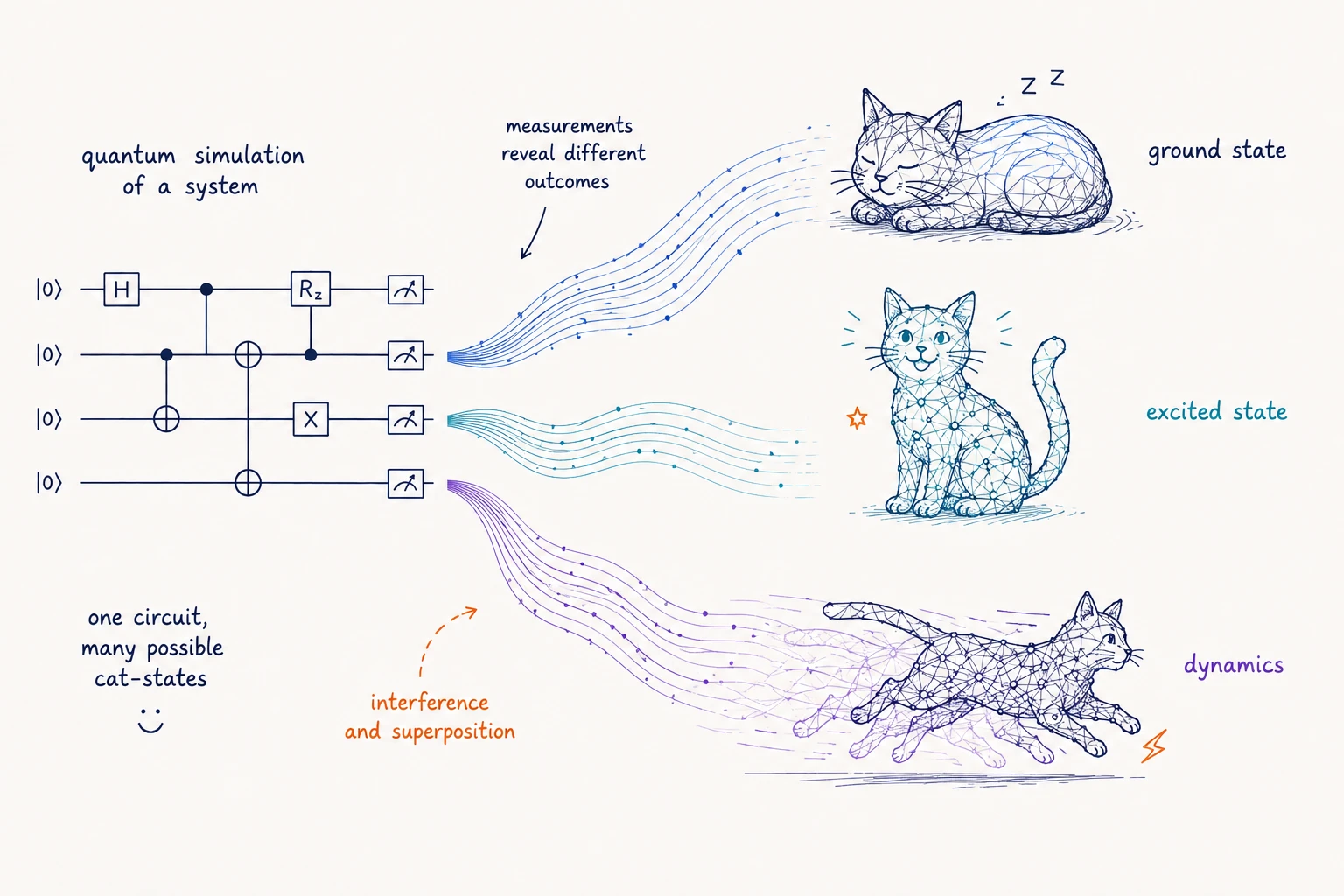
Today’s processors are good enough to probe physics that is otherwise hard to reach. Using holographic (qubit-efficient) tensor-network circuits and trapped-ion hardware, I study non-Hermitian dynamics, thermal states, and mixed-state phases of matter — phases that exist only in the presence of noise, and whose order parameters turn out to be tied to quantum error correction.
- Probing mixed-state phases on a quantum computer via Rényi correlators and variational decoding — Nature Communications (2026)
- Observation of a non-Hermitian supersonic mode on a trapped-ion quantum computer — Nature Communications 16, 3286 (2025)
- Holographic simulation of correlated electrons on a trapped-ion quantum processor — PRX Quantum 3, 030317 (2022)
- Holographic quantum simulation of entanglement renormalization circuits — PRX Quantum 4, 030334 (2023)
Machine learning for quantum computing
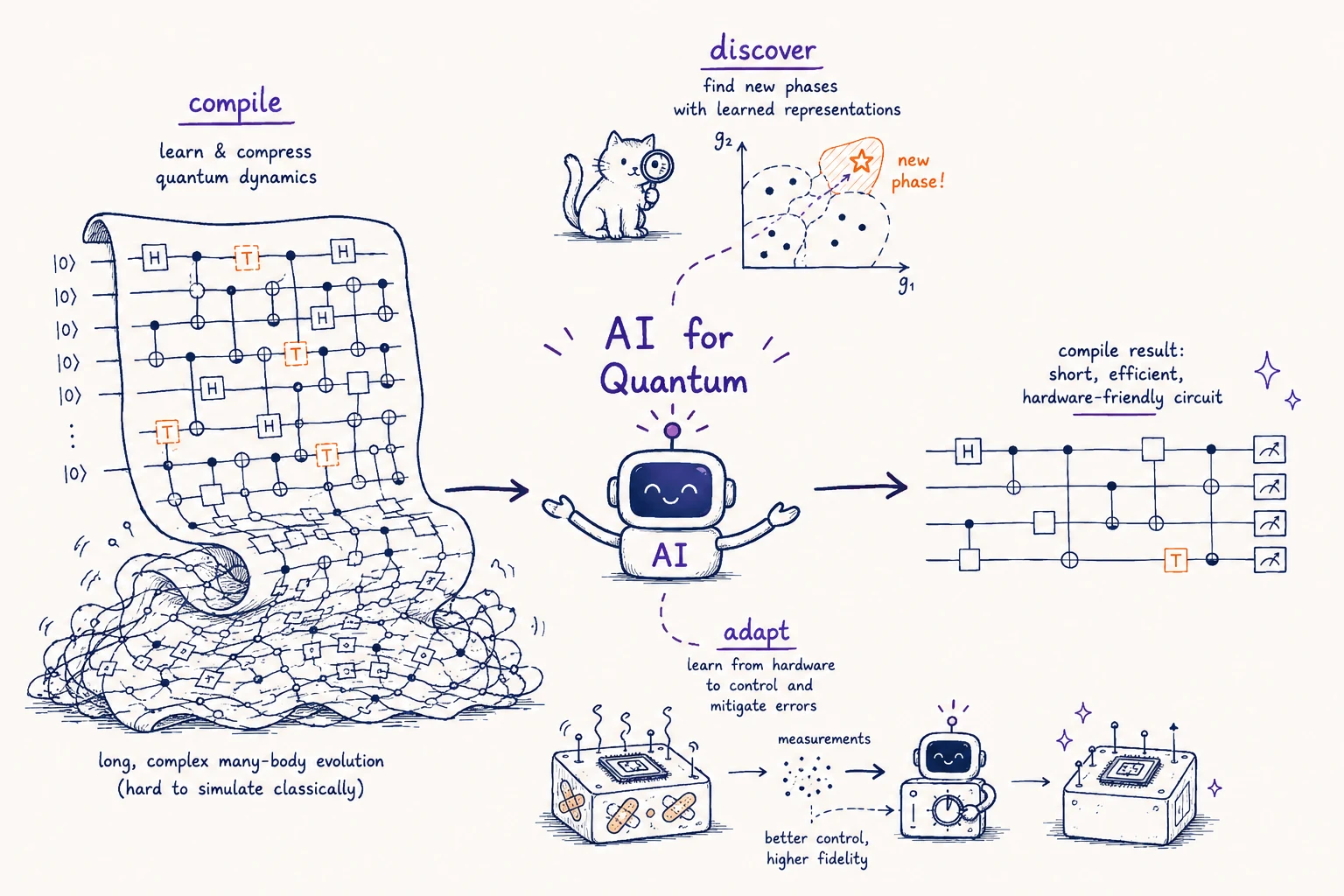
Running anything on a quantum computer today means a long chain of hand-made decisions: choosing a circuit, compiling it, calibrating the device, mitigating errors, and checking the output. I think most of that chain should be learned rather than hand-designed. So far my work has automated the compile step — turning long many-body dynamics into much shorter, hardware-friendly circuits — and used neural quantum states to discover phases and phase boundaries in systems where conventional methods struggle. The direction I am pushing now extends this to the rest of the pipeline: learning noise models and control strategies directly from device data, in which error mitigation is one component rather than a field of its own.
- Scalable quantum dynamics compilation via quantum machine learning — Phys. Rev. Research 8, 023128 (2026)
- Biorthogonal neural network approach to two-dimensional non-Hermitian systems — Phys. Rev. Lett. 136, 126501 (2026)
- Circuit compression for 2D quantum dynamics — arXiv:2507.01883
Earlier work. Benchmarking and architecture for photonic quantum processors — quantum volume for photonic processors (Phys. Rev. Lett. 130, 110602), all-photonic one-way quantum repeaters (npj Quantum Information 9, 106), and quantum algorithms for network-flow optimisation (Quantum 5, 510). Full list on the publications page.